
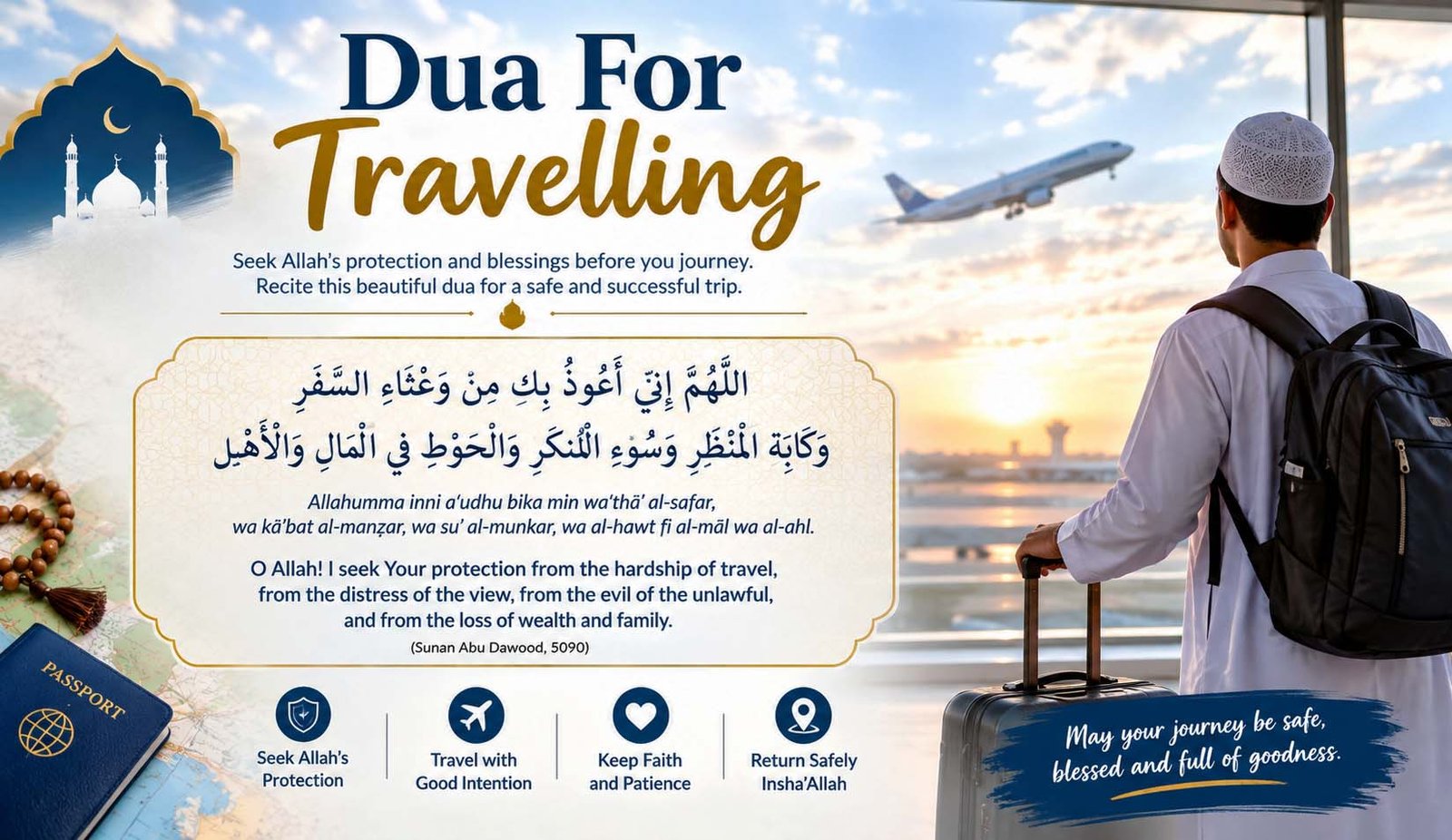
Dua for Travelling: The Complete Guide to a Blessed, Protected Journey
Seven authentic duas — from the moment you step out of your door to the moment you return — in Arabic, transliteration, and plain English, sourced from the Qur’an and Sahih Hadith.
Travel unsettles even the most prepared among us — a delayed flight, an unfamiliar road, a family left behind for a few days. Islam meets that unease with something concrete: a set of duas the Prophet Muhammad (peace be upon him) himself recited and taught, one for each stage of a journey. They are not superstition or ritual for its own sake. They are a way of placing the outcome of the trip — safe or hard, short or long — in Allah’s hands before it begins.
Below is the traveller’s dua in full: what to say before you leave home, when you board your vehicle, during the journey itself, on arrival, and when you finally return. Each one includes the Arabic text, a transliteration for those still learning to read Arabic, and its meaning in English.
Why the Traveller’s Dua Matters
The Prophet (peace be upon him) singled out the traveller’s supplication as one that Allah does not turn away. Abu Hurairah reported him saying that three prayers go unrejected: the prayer of someone wronged, the prayer of a parent for their child, and the prayer of the traveller (Sunan al-Tirmidhi 3448, graded hasan). That alone is reason to make dua a habit before every trip, long or short, by plane, car, or on foot.
1. Dua for Leaving Home
Said as you step out the door, this short dua asks for Allah’s protection over the whole outing — not just the trip itself, but everything you might otherwise stumble into or overlook along the way.
On stepping outside
|
بِسْمِ اللَّهِ، تَوَكَّلْتُ عَلَى اللَّهِ، وَلَا حَوْلَ وَلَا قُوَّةَ إِلَّا بِاللَّهِ Bismillahi, tawakkaltu ‘alallahi, wa la hawla wa la quwwata illa billah. “In the name of Allah, I place my trust in Allah. There is no power and no strength except with Allah.” |
Reference: Sunan Abi Dawud 5095, Sunan al-Tirmidhi 3426
2. Dua for Boarding a Vehicle
This dua comes directly from the Quran. Allah instructs the believer to remember His favour the moment they are seated – on a plane, in a car, on a ship – because reaching a destination safely is never guaranteed by our own effort alone.
Once seated — car, plane, train or ship
|
سُبْحَانَ الَّذِي سَخَّرَ لَنَا هَذَا وَمَا كُنَّا لَهُ مُقْرِنِينَ وَإِنَّا إِلَى رَبِّنَا لَمُنقَلِبُونَ Subhanal-ladhi sakhkhara lana hadha wa ma kunna lahu muqrinin, wa inna ila Rabbina lamunqalibun. “Glory be to Him who has made this subservient to us, though we could never have done so ourselves. And indeed, to our Lord we will return.” |
Reference: Qur’an 43:13-14 (Surah Az-Zukhruf), also recorded in Sahih Muslim
3. Dua for the Journey (Safar)
This is the fuller supplication the Prophet (peace be upon him) would recite once the journey was underway, asking not just for safety but for the trip to be spiritually worthwhile.
Once the journey has begun
|
اللَّهُمَّ إِنَّا نَسْأَلُكَ فِي سَفَرِنَا هَذَا الْبِرَّ وَالتَّقْوَى، وَمِنَ الْعَمَلِ مَا تَرْضَى، اللَّهُمَّ هَوِّنْ عَلَيْنَا سَفَرَنَا هَذَا وَاطْوِ عَنَّا بُعْدَهُ، اللَّهُمَّ أَنْتَ الصَّاحِبُ فِي السَّفَرِ وَالْخَلِيفَةُ فِي الْأَهْلِ Allahumma inna nas’aluka fi safarina hadhal-birra wat-taqwa, wa minal-‘amali ma tarda. Allahumma hawwin ‘alayna safarana hadha wa-twi ‘anna bu’dah. Allahumma antas-sahibu fis-safari wal-khalifatu fil-ahl. “O Allah, we ask You on this journey of ours for righteousness, piety, and deeds that please You. O Allah, make this journey easy for us and shorten its distance. O Allah, You are our Companion on the road and the Guardian of our family in our absence.” |
Reference: Sahih Muslim 1342
4. Dua for Protection from Hardship
Travel wears people down in small ways — bad food, poor sleep, delays, coming home to find something out of place. This dua asks specifically to be spared those ordinary miseries.
For hardship, weariness or a bad return
|
اللَّهُمَّ إِنِّي أَعُوذُ بِكَ مِنْ وَعْثَاءِ السَّفَرِ، وَكَآبَةِ الْمَنْظَرِ، وَسُوءِ الْمُنْقَلَبِ فِي الْمَالِ وَالْأَهْلِ Allahumma inni a’udhu bika min wa’tha’is-safari, wa ka’abatil-manzari, wa su’il-munqalabi fil-mali wal-ahl. “O Allah, I seek refuge in You from the hardship of travel, from a distressing sight, and from finding on my return that my wealth or family has come to harm.” |
Reference: Sahih Muslim 1343
5. Dua on Arriving at a Destination
Arriving somewhere new — a hotel, a relative’s home, a rest stop — is its own small vulnerability. This dua was taught by the Prophet (peace be upon him) to a woman troubled by a scorpion near her camp, and it covers every kind of harm a new place might hold.
On reaching a new place
|
أَعُوذُ بِكَلِمَاتِ اللَّهِ التَّامَّاتِ مِنْ شَرِّ مَا خَلَقَ A’udhu bikalimatillahit-tammati min sharri ma khalaq. “I seek refuge in the perfect words of Allah from the evil of what He has created.” |
Reference: Sahih Muslim 2708
Whoever recites it on arrival, the Prophet (peace be upon him) said, nothing will harm them until they leave that place.
6. Dua for Returning Home
The final dua is one of gratitude — said as the journey ends and home comes back into view, acknowledging that the safe return itself was a favour, not a given.
On the way home
|
آيِبُونَ، تَائِبُونَ، عَابِدُونَ، لِرَبِّنَا حَامِدُونَ Ayibuna, ta’ibuna, ‘abiduna, li-Rabbina hamidun. “We return, repentant, worshipping, and praising our Lord.” |
Reference: Sahih Muslim 1344, Sahih al-Bukhari 1797
Etiquette Around Travel Dua
- Recite with intention, not just habit. A few seconds of genuine reflection matters more than fast, distracted recitation.
- Say them at their proper moment where possible — leaving the house, boarding, mid-journey, arriving, returning — rather than all at once beforehand.
- Travel also comes with concessions (qasr — shortening the four-unit prayers to two, and combining Dhuhr with Asr or Maghrib with Isha), which many travellers overlook alongside the dua itself.
- Keep the duas somewhere accessible — a saved note or photo — for the moments memory fails you.
Frequently Asked Questions
What is the main dua for travelling in Islam?
The one most commonly recited is the vehicle-boarding dua from Qur’an 43:13-14: “Subhanal-ladhi sakhkhara lana hadha…” It is short, easy to memorise, and appropriate for any mode of transport.
Is the traveller’s dua always answered?
The Prophet (peace be upon him) described the traveller’s prayer as one of three supplications that are not rejected (Sunan al-Tirmidhi 3448). This is a strong promise, though as with all dua, timing and wisdom rest with Allah.
Can I read these duas from my phone instead of memorising them?
Yes. Reading from a phone, an app, or a printed card is entirely acceptable — what matters is sincerity, not memorisation.
Do these duas apply to Umrah and Hajj travel too?
Yes — these are the general duas for any journey, including travel for Umrah or Hajj. Pilgrims recite them the same way alongside the specific rites of ihram and talbiyah once those begin.