
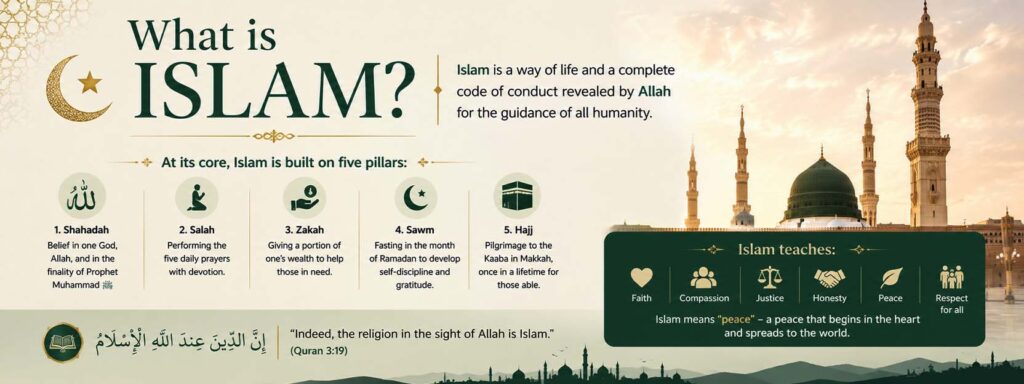
What is Islam? A Complete Guide
1. The Meaning of Islam
The word Islam is derived from the Arabic trilateral root s-l-m (سلم), which carries the meanings of peace, safety, and surrender. In its religious sense, Islam means voluntary submission to God’s will. A person who practices Islam is called a Muslim — one who submits.
Islam is not simply a religion but a complete way of life (دين, deen) that governs worship, morality, family life, social conduct, economics, and governance.
2. Who Are Muslims?
Muslims are followers of Islam. They believe in one God — Allah — and that Prophet Muhammad ﷺ is His final messenger. Muslims exist on every continent and represent a vast diversity of ethnicities, cultures, and languages. Key demographic facts:
- Over 1.9 billion Muslims worldwide (approximately 24% of the global population)
- The largest Muslim-majority country is Indonesia
- Around 62% of Muslims live in Asia-Pacific
- Significant Muslim communities exist in Europe, the Americas, and Sub-Saharan Africa
- Islam is the fastest-growing religion in the world
3. The Six Articles of Faith (Iman)
Islamic belief is structured around six essential articles of faith (Arkan al-Iman). Every Muslim must believe in all six:
- Belief in Allah: Absolute monotheism — there is no god but Allah (Tawhid)
- Belief in Angels (Malaika): Unseen beings created from light who serve and obey Allah
- Belief in the Holy Books: The Quran, Torah, Psalms, and Gospel were all revealed by Allah
- Belief in the Prophets (Anbiya): From Adam to Muhammad ﷺ — the final prophet
- Belief in the Day of Judgement (Qiyamah): Every soul will be held accountable for its deeds
- Belief in Divine Decree (Qadar): Allah has knowledge and control of all things
4. The Five Pillars of Islam
The Five Pillars of Islam (Arkan al-Islam) are the foundational acts of worship that every adult Muslim is obligated to perform. They form the framework of a Muslim’s daily life and relationship with Allah.
Shahada — The Declaration of Faith
The Shahada is the first and most fundamental pillar: “La ilaha illallah, Muhammadur Rasulullah” — There is no god but Allah, and Muhammad is His messenger. Reciting the Shahada with sincere belief and understanding is the entry point into Islam.
Salah — The Five Daily Prayers
Muslims pray five times daily — at Fajr (dawn), Dhuhr (midday), Asr (afternoon), Maghrib (sunset), and Isha (night). Prayer is preceded by ritual purification (Wudu) and performed facing the Kaaba in Mecca. Salah keeps a Muslim connected to Allah throughout the day.
Zakat — Obligatory Charity
Zakat is a mandatory annual almsgiving of 2.5% of a Muslim’s saved wealth above a minimum threshold (Nisab), distributed to the poor, the needy, and other eligible categories. It purifies wealth and fosters social justice.
Sawm — Fasting in Ramadan
During the holy month of Ramadan, Muslims fast from dawn to sunset — abstaining from food, drink, and sinful behavior. Fasting builds spiritual discipline, gratitude, and empathy for those in need.
Hajj — The Sacred Pilgrimage
Every Muslim who is physically and financially able must perform Hajj at least once in their lifetime. Hajj is an annual pilgrimage to Mecca, Saudi Arabia, in the Islamic month of Dhul Hijjah. It commemorates the trials of Prophet Ibrahim (Abraham) ﷺ and his family.
5. The Holy Quran and Hadith
The two primary sources of Islamic knowledge and law are:
- The Holy Quran: The literal word of Allah, revealed to Prophet Muhammad ﷺ through the Angel Jibreel (Gabriel) over 23 years. It consists of 114 Surahs (chapters) and serves as the ultimate guide for all aspects of life.
- The Hadith: The recorded sayings, actions, and approvals of Prophet Muhammad ﷺ. Together with the Quran, they form the Sunnah — the prophetic model of conduct.
“Indeed, this Quran guides to that which is most suitable and gives good tidings to the believers who do righteous deeds that they will have a great reward.”
— Surah Al-Isra, 17:9
6. A Brief History of Islam
Islam began in 610 CE when Prophet Muhammad ﷺ received the first revelation in the Cave of Hira, near Mecca. Key milestones include:
- 610 CE: First revelation of the Quran to Prophet Muhammad ﷺ
- 622 CE: The Hijra — migration from Mecca to Medina, marking the start of the Islamic calendar
- 630 CE: The peaceful conquest of Mecca and establishment of Islamic governance
- 632 CE: The passing of Prophet Muhammad ﷺ after completing his mission
- 7th–13th century: The Islamic Golden Age — advancements in science, medicine, mathematics, and philosophy
- Today: Islam is practiced across 50+ Muslim-majority countries and every continent
7. Islam and Other Abrahamic Faiths
Islam is part of the Abrahamic family of religions, sharing roots with Judaism and Christianity. Muslims revere many of the same prophets — including Ibrahim (Abraham), Musa (Moses), and Isa (Jesus) ﷺ — while affirming that Prophet Muhammad ﷺ is the seal of the prophets (Khatam an-Nabiyyin).
- All three faiths believe in one God and divine revelation
- Muslims respect Jesus ﷺ as a great prophet, not divine
- The Quran references many narratives from the Torah and Gospel
- Islam views itself as the final and complete form of God’s message
8. Core Values and Teachings of Islam
Islam promotes a balanced and ethical way of life. Its core values include:
- Tawhid (Monotheism): Believing in the absolute oneness of Allah
- Justice (Adl): Fairness in all dealings, social and personal
- Compassion (Rahma): Kindness toward all of creation — humans, animals, and the environment
- Knowledge (Ilm): Seeking knowledge is obligatory for every Muslim
- Family: The family unit is the cornerstone of Islamic society
- Honesty (Sidq): Truthfulness in words, transactions, and character
- Community (Ummah): Muslims form a global brotherhood and sisterhood