
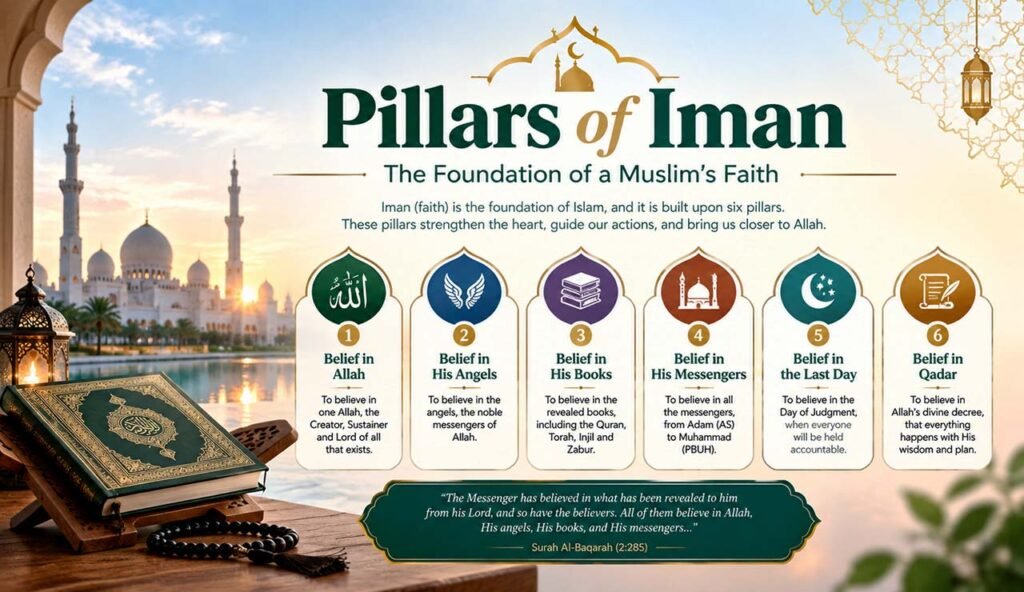
Pillars of Iman: The 6 Articles of Faith Every Muslim Should Know
Iman, or faith, is the foundation upon which the entire structure of Islam is built. While the Five Pillars of Islam represent the physical acts of worship, the Pillars of Iman represent the beliefs of the heart — the unseen convictions that give those actions meaning. In this article, we explore all six pillars of iman in detail, supported by verses from the Quran and authentic hadith.
What Is Iman in Islam?
The Arabic word iman comes from a root meaning “to be secure” or “to trust.” In Islamic terminology, it refers to firm belief in the heart, confirmed by the tongue, and expressed through the actions of the limbs. Iman is not simply an intellectual acknowledgment — it is a living conviction that shapes how a believer thinks, speaks, and acts every day.
The Hadith of Jibreel: Where the Pillars Come From
The clearest explanation of the six pillars of iman comes from the famous Hadith of Jibreel (Gabriel), narrated by Umar ibn al-Khattab. In this hadith, the Angel Jibreel appeared to the Prophet Muhammad ﷺ in the form of a man and asked him to define iman.
The Prophet ﷺ answered that faith means affirming Allah, His angels, His books, His messengers, the Last Day, and accepting divine decree in both its good and difficult forms. — Summarized from Sahih Muslim, Hadith 8 (Hadith of Jibreel)
This single narration became the primary reference point that scholars use to outline the six pillars of iman.
1. Belief in Allah:
The first and greatest pillar is believing firmly in the existence, oneness, and lordship of Allah — that He alone is the Creator, Sustainer, and Master of the universe, and that He alone deserves to be worshipped. This concept is known as Tawheed.
Allah affirms in the Quran that He is the One God, the Self-Sufficient Master whom all creation depends upon, who was not born and does not give birth, and to whom nothing is comparable. — Meaning conveyed in Surah Al-Ikhlas, 112:1-4
Belief in Allah also includes affirming His beautiful names and perfect attributes, such as His mercy, knowledge, and power, without distortion or comparison to creation.
2. Belief in the Angels:
Muslims believe that Allah created angels from light, and that they are honored creations who never disobey His commands. They carry out specific duties, such as Jibreel delivering revelation, or the angels who record each person’s deeds.
The Quran describes angels as honored servants who never precede Allah in speech and who act only upon His command. — Meaning conveyed in Surah Al-Anbiya, 21:26-27
3. Belief in the Revealed Books:
This pillar involves believing that Allah sent down scriptures to guide humanity, including the Scrolls of Ibrahim, the Torah given to Musa, the Zabur given to Dawud, the Injeel given to Isa, and finally the Quran given to Muhammad ﷺ — the final and unaltered revelation.
Allah states that He has sent down the Quran and that He Himself will preserve it from corruption. — Meaning conveyed in Surah Al-Hijr, 15:9
4. Belief in the Messengers:
Muslims must believe that Allah sent prophets and messengers to every nation to convey His message and guide people to the straight path, from Adam to Muhammad ﷺ, the final messenger.
The Quran explains that a messenger was raised among every community, calling people to worship Allah alone and avoid false gods. — Meaning conveyed in Surah An-Nahl, 16:36
Believers are required to honor all prophets without discrimination while recognizing Muhammad ﷺ as the seal of prophethood.
5. Belief in the Day of Judgment:
This pillar requires firm conviction that life in this world will end, and that every soul will be resurrected to be held accountable for its deeds — rewarded with Paradise or punished in Hellfire based on Allah’s justice and mercy.
The Quran warns that on that Day, whoever has done even an atom’s weight of good will see it, and whoever has done an atom’s weight of evil will see it as well. — Meaning conveyed in Surah Az-Zalzalah, 99:7-8
6. Belief in Qadr (Divine Decree):
The final pillar is belief in Qadr — that Allah has full knowledge of all things, has written their outcomes, and that nothing occurs except by His will, whether it appears to be good or difficult for the individual. This belief brings a Muslim tranquility, knowing that every trial and blessing carries divine wisdom.
The Prophet ﷺ taught that a believer’s affairs are a source of wonder, because in times of ease he is grateful, and in times of hardship he is patient, and both bring him good. — Summarized from Sahih Muslim, Hadith 2999
Why the Pillars of Iman Matter Today
Understanding these six pillars gives structure and depth to a Muslim’s spiritual life. They are not abstract theology; each pillar directly shapes daily behavior:
- Belief in Allah builds sincerity and humility in worship.
- Belief in Angels increases awareness of being watched and recorded.
- Belief in the Books connects believers to a long chain of divine guidance.
- Belief in the Messengers provides practical role models to follow.
- Belief in the Last Day motivates accountability and good conduct.
- Belief in Qadr produces patience, gratitude, and inner peace.
Frequently Asked Questions
What are the 6 Pillars of Iman?
Belief in Allah, His Angels, His Books, His Messengers, the Last Day, and Qadr (divine decree, both good and bad).
What is the difference between the Pillars of Islam and the Pillars of Iman?
The Pillars of Islam are outward acts of worship (Shahada, Salah, Zakah, Sawm, Hajj), while the Pillars of Iman are the inward beliefs of the heart that give those acts meaning.
Where are the Pillars of Iman mentioned in the Quran and Hadith?
They are reflected in Surah Al-Baqarah (2:285) and explained in full detail in the Hadith of Jibreel found in Sahih Muslim.
Want to deepen your understanding of Islamic beliefs and prepare spiritually for your next journey? Explore our Umrah packages and guided learning resources.