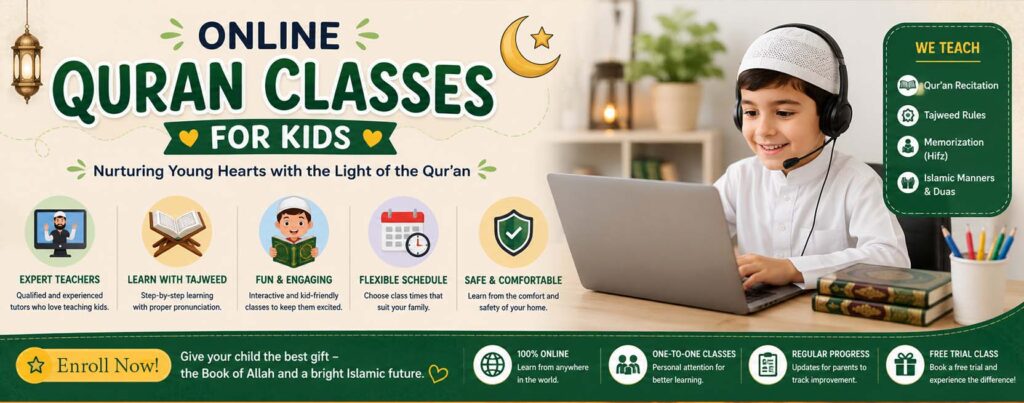
Online Quran Classes for Kids: The Complete Parent’s Guide
As a Muslim parent, one of your greatest responsibilities is helping your child build a strong connection with the Quran. But finding a qualified teacher, managing schedules, and ensuring a safe learning environment can feel overwhelming — especially in today’s busy world.
That is where online Quran classes for kids come in.
Whether you live in a country with limited access to Islamic education or simply want a flexible, professional learning experience for your child, enrolling in an online Quran academy has never been easier or more effective.
In this guide, you will discover:
- Why online Quran classes are ideal for children
- What subjects are covered
- How to choose the best online Quran academy
- What to expect from a trial class
- Frequently asked questions from parents.
Let’s get started.
Why Choose Online Quran Classes for Kids?
Many parents wonder whether online learning can match the quality of in-person teaching. The answer, in most cases, is yes — and often it surpasses it. Here is why thousands of Muslim families are switching to online Quran education.
1. Learn from Certified, Native Arab Teachers
Top online Quran academies hire teachers who are native Arabic speakers with an Ijazah — a formal Islamic certification to teach the Quran. This means your child learns correct Tajweed (pronunciation rules) from day one, building a solid foundation that in-person tutors without certification may not provide.
2. Flexible Scheduling That Fits Family Life
Unlike traditional madrassas with fixed hours, online Quran classes work around your family’s schedule. Classes can be booked in the morning before school, in the evening, or even on weekends. This flexibility removes the stress of daily commutes and ensures your child never misses a lesson.
3. One-on-One Attention for Every Child
Most online Quran academies offer one-to-one sessions, meaning your child receives the teacher’s full attention. This personalized approach allows the tutor to adapt the pace and teaching style to your child’s learning pace — something rarely possible in a group madrassa setting.
4. A Safe and Comfortable Learning Environment
Children learn best when they feel safe. Learning from home removes social anxiety, eliminates commuting risks, and allows parents to sit in and monitor sessions whenever they wish. Full transparency is a core feature of reputable online Quran academies.
5. Affordable Pricing for Every Budget
Online Quran classes are significantly more affordable than hiring a private in-home tutor. Many academies offer tiered plans, sibling discounts, and even free trial classes so you can assess the quality before committing.
What Do Online Quran Classes for Kids Cover?
A quality online Quran academy does not just teach recitation — it covers a broad Islamic curriculum designed to nurture your child’s faith and knowledge. Here is what most programs include:
Qaida / Noorani Qaida
This is the starting point for young beginners. The Noorani Qaida teaches children how to recognize Arabic letters, connect them into words, and begin reading the Quran correctly. Most children aged 4–7 begin here.
Quran Reading with Tajweed
Once a child can recognize letters, they move on to reading full Quran verses. Tajweed — the rules governing correct pronunciation — is taught alongside reading to ensure every letter and sound is produced accurately. Learning Tajweed from a young age is far easier than correcting habits in adulthood.
Quran Memorization (Hifz)
For families whose goal is for their child to become a Hafiz or Hafiza (one who has memorized the entire Quran), online Hifz programs offer structured memorization plans with daily revision, progress tracking, and supportive teachers who celebrate every milestone.
Islamic Studies
Beyond Quran, many online academies offer supplementary Islamic studies covering the five pillars of Islam, the Prophet’s life (Seerah), basic Fiqh (Islamic jurisprudence), and Duas (supplications) for daily life. This well-rounded curriculum helps children grow as confident, informed Muslims.
Arabic Language
Learning Arabic empowers children to understand the Quran directly — without needing a translation. Many online academies offer beginner Arabic courses as an add-on to Quran classes.
How to Choose the Best Online Quran Academy for Your Child
With so many options available, it can be difficult to know which academy to trust. Use this checklist when evaluating any online Quran program for your child:
✅ Qualified, Ijazah-Certified Teachers
Always ask whether teachers hold a formal Ijazah. This certification confirms they have been trained and authorized to teach the Quran.
Always ask whether teachers hold a formal Ijazah. This certification confirms they have been trained and authorized to teach the Quran.
✅ Free Trial Class
A reputable academy will always offer a free trial class. This allows your child to meet the teacher, experience the teaching style, and decide whether the fit feels right — with no financial risk.
A reputable academy will always offer a free trial class. This allows your child to meet the teacher, experience the teaching style, and decide whether the fit feels right — with no financial risk.
✅ Female Teachers Available
For families who prefer female tutors for their daughters, ensure the academy employs qualified female Quran teachers.
For families who prefer female tutors for their daughters, ensure the academy employs qualified female Quran teachers.
✅ Progress Tracking and Parental Reports
Good academies provide regular updates on your child’s progress, including which Surahs have been memorized, Tajweed errors to work on, and overall performance feedback.
Good academies provide regular updates on your child’s progress, including which Surahs have been memorized, Tajweed errors to work on, and overall performance feedback.
✅ Flexible Cancellation Policy
Life happens. Choose an academy that allows you to reschedule or cancel sessions without heavy penalties.
Life happens. Choose an academy that allows you to reschedule or cancel sessions without heavy penalties.
✅ Secure Video Platform
Classes should be conducted on a secure, reputable video platform (such as Zoom or Skype) to protect your child’s privacy.
Classes should be conducted on a secure, reputable video platform (such as Zoom or Skype) to protect your child’s privacy.
At what age can children start online Quran Classes?
Children as young as 4 years old can begin online Quran classes. At this age, sessions are kept short (15–20 minutes) and highly interactive to match young attention spans. Teachers use colorful visuals, Arabic alphabet games, and positive reinforcement to make learning enjoyable.
By age 6–7, most children are ready for 30-minute sessions and can begin structured Quran reading. By 8–10, many students are ready to begin Hifz (memorization) if the family chooses that path.
The important thing is not to wait. The earlier a child begins, the more natural Arabic pronunciation becomes and the faster they progress.
A Typical Online Quran Class: What to Expect
Many parents are curious about what actually happens during an online session. Here is a sample structure for a 30-minute class:
| 0–5 min | Warm-up: revision of previous lesson |
| 5–20 min | New lesson: new letters, words, or verses |
| 20–25 min | Practice and correction with teacher feedback |
| 25–30 min | Homework assignment and encouragement |
Teachers use screen sharing, digital whiteboards, and interactive Quran apps to keep the session engaging. Parents are always welcome to observe.
Tips to Help Your Child Succeed in Online Quran Classes
Enrolling your child is just the first step. Here is how to make the most of their Quran education:
Create a dedicated learning space. Set up a quiet, distraction-free area with a good internet connection, a working microphone, and a comfortable chair. Treating Quran class like school sends the right message about its importance.
Establish a consistent routine. Children thrive on routine. Hold Quran class at the same time each day so it becomes a natural part of their schedule.
Revise daily — even for 10 minutes. Between formal sessions, a short daily revision of what was taught reinforces memory and dramatically accelerates progress.
Celebrate milestones. When your child memorizes a new Surah, reads a page correctly, or receives a positive report, celebrate it. Positive reinforcement builds lasting motivation.
Be patient. Every child learns at a different pace. Trust the process, stay consistent, and remember that even a few Ayahs memorized with love and dedication are deeply valuable.